SCIENCE
The First-in-Class In-Vivo Protein Engineering Platform

T-cell engagers and CAR-T have shown that redirecting T cells against tumor cells works — but every existing approach is bottlenecked by manufacturing complexity, narrow safety windows, lymphodepletion, repeat dosing, or short half-lives.
TransJoin™ removes those bottlenecks. Using non-integrating vectors for In-Vivo Protein Engineering, we instruct the patient’s liver to produce a bispecific T-cell engager continuously from a single IV dose — delivering year-plus sustained expression with off-the-shelf production and a gentler safety profile than CAR-T, bispecifics, or ADCs.
TRANSJOIN’S DRAG-AND-DROP
APPROACH TO BUILDING IN VIVO
THERAPIES
THERAPIES
Our patented, drag-and-drop TransJoin™ platform turns the patient’s own liver into a continuous biofactory for bispecific T-cell engagers — an off-the-shelf, single-dose therapy that delivers durable T-cell-mediated tumor killing without ex vivo manufacturing, lymphodepletion, or repeat infusion.
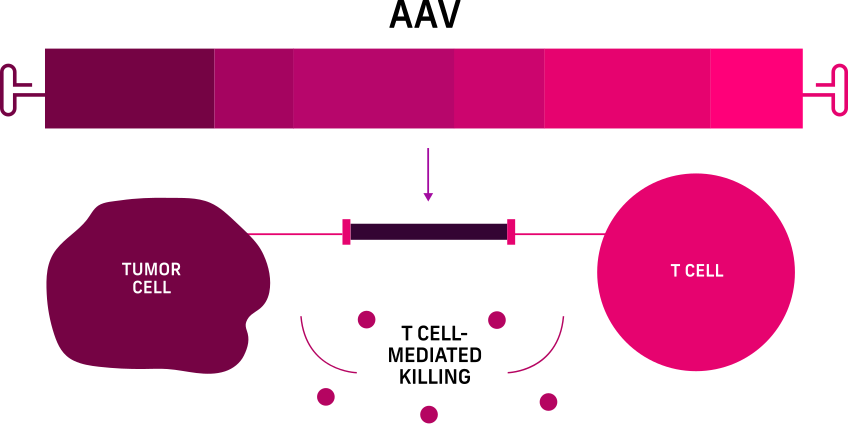
Each TransJoin construct encodes a bispecific protein with a target-antigen. The target-antigen is the only component swapped between programs — CD19, HER2, BCMA/GPRC5D, GD2, PSMA, MSLN, B7H3, GP350, and beyond — enabling rapid pipeline expansion with the same manufacturing process and delivery format.
Following a one-time IV infusion, a low-dose, non-integrating vector delivers genetic instructions for In-Vivo Protein Engineering to the liver, where hepatocytes continuously secrete the bispecific protein into the bloodstream. This produces sustained, steady-state therapeutic exposure for months to years from a single dose — with a gentler rise in exposure than recombinant or cell-based alternatives.
The following table lays out how TransJoin’s potential stacks up against other available CD19-targeted immunotherapy classes, including CAR-T (chimeric antigen receptor T cell therapy).
| Differentiators of CD19-Targeted Therapies | CAR-T | TransJoin |
|---|---|---|
| Off-the-shelf | No | Yes |
| Single dose | Yes | Yes |
| Long-term efficacy (months to years) | Yes | Yes |
| Involves all T cells | No | Yes |
| Recruits freshly made T cells from bone marrow | No | Yes |
| Highly efficient T cell signaling (via the mature T cell receptor) | No | Yes |
| Risk of manufacturing failure | Yes | No |
| Requires chemotherapy conditioning | Yes | No |

The Landmark Published Research Behind Vironexis
TransJoin’s foundational technology was licensed from Nationwide Children’s Hospital.
In 2022, research led by Timothy Cripe, M.D., Ph.D. — Chief of the Division of Pediatric Hematology/Oncology/Bone and Marrow Transplant at Nationwide Children’s, and a Vironexis co-founder — describing the TransJoin approach was published in Science Advances.
Bringing TransJoin to Patients
With one platform, one capsid, and one manufacturing process, we are advancing 10+ candidates spanning hematologic malignancies, solid tumors, and immune disorders. Our two lead programs — VNX-101 (CD19+ leukemias and lymphomas) and VNX-202 (HER2+ cancers) — are in Phase 1/2 trials, both with FDA Fast Track Designation.
Learn More About Our Pipeline